 By Dr 'Timi | Bishop & Mentor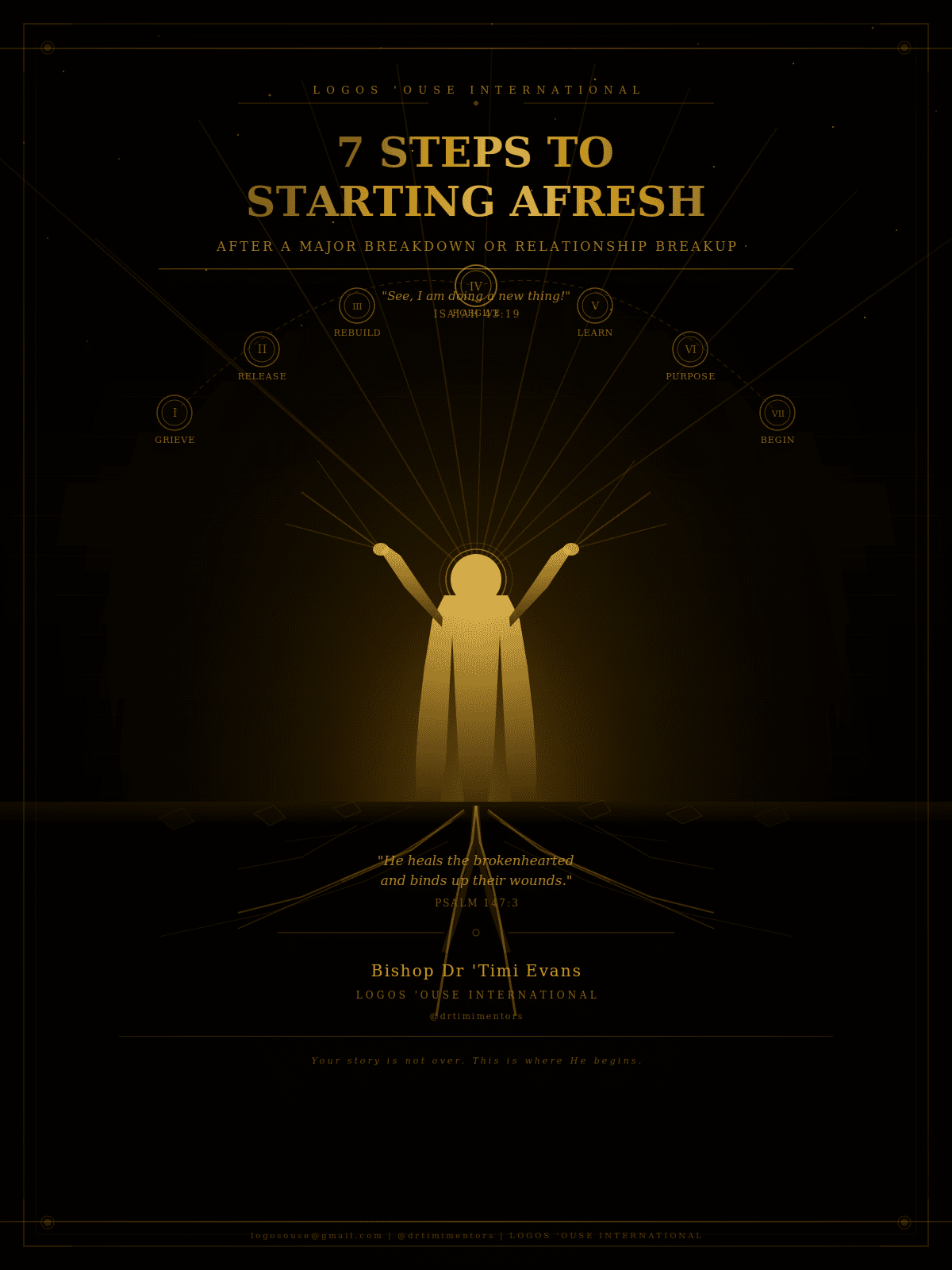
7 Steps to Starting Afresh After a Major Breakdown or Relationship Breakup By Bishop Dr ‘Timi Evans — Logos ‘Ouse International
There are moments in life that do not simply slow you down. They stop you. Completely. Without warning and without courtesy.
A relationship ends. A season you gave everything to collapses. A version of your future that you had carefully, quietly, faithfully constructed over months or years now lies in pieces around your feet. And you are standing in the middle of it, not quite sure what to do with your hands.
I have sat with many people in that place. Men and women who love God, who prayed, who were committed, who did everything they believed was right and still found themselves in the rubble of something they did not ask for. I have listened to them try to put words around what they were feeling, and watched how often the words were not enough.
So I want to say this before anything else: what you are feeling is not a sign that your faith has failed. It is a sign that something mattered. Pain is always proportionate to investment. You do not grieve what you never loved.
This is not a motivational address. I am not here to hype you into a performance of recovery. This is a map, drawn from years of walking alongside people through valleys. It is written for the person who is still sitting in the quiet of what used to be, trying to find a way forward that feels honest and not just busy.
Here are seven steps to starting afresh.
Step I — Allow Yourself to Grieve
The most important step is the one almost everyone skips.
They skip it because the world rewards speed. Because grief looks like weakness from the outside. Because there is always something to do, somewhere to be, someone watching. So they bury the grief under activity. They move into the next relationship, the next city, the next project before they have ever been honest about what they lost. And they call it strength. But it is not strength. It is avoidance wearing a productive face.
You cannot heal what you refuse to feel. That is not a motivational phrase. That is physiology, theology and pastoral reality all arriving at the same conclusion.
Grief is the soul’s honest response to genuine loss. It is not a spiritual failure. It is not immaturity. It is the evidence that you were present, that you were invested, that you loved. The Psalms are full of it. The prophets wept. Jesus wept at the tomb of Lazarus even though He knew what was about to happen. Grief is not the absence of faith. It is faith being honest about what it is carrying.
So sit with it. Not indefinitely. But long enough to be truthful with yourself about the weight of what has changed. Let the tears come if they come. Let the silence be what it is. Do not perform recovery for people who are watching. Do not skip the valley because you are embarrassed to be seen in it.
God does not require you to compose yourself before He comes near. He is described in Scripture as one who draws close to the brokenhearted, who binds up wounds, who meets people in grief rather than waiting for them to emerge from it first.
“He heals the brokenhearted and binds up their wounds.” — Psalm 147:3
Step II — Refuse the Blame Spiral
Once the grief begins to settle, something else moves in. Something quieter but equally destructive. The relentless, exhausting search for who is to blame.
And the most dangerous version of that search is the one that turns entirely inward.
You replay conversations that are six months old. You revisit decisions. You reconstruct arguments and find all the places where you could have said something different, chosen differently, seen it coming. And what begins as healthy reflection quietly curdles into something that is no longer honest assessment. It becomes a kind of self-trial, where you are simultaneously the prosecutor, the defendant and the judge, and the verdict is always the same.
There is a distinction that matters enormously here. Taking honest responsibility sounds like: “I can see what I contributed. I know what was mine to own. I am choosing to learn from this.” Self-condemnation sounds like: “I am the problem. I always destroy things. Nothing will change because I am who I am.” One of those leads to growth. The other keeps you circling the same courtroom indefinitely.
Look at what was yours. Look at it clearly and without flinching. Acknowledge it. Repent where repentance is needed. And then close the case.
You are not the sum of your worst season. God knew everything that would happen in this chapter of your life and He called you anyway. He did not revise His plan when you fell short. His purposes are not that fragile.
“There is therefore now no condemnation to those who are in Christ Jesus.” — Romans 8:1
Step III — Rebuild Your Identity in God
One of the quietest casualties of a painful ending is identity. You may not notice it while everything is still raw. But as the weeks pass, a slow disorientation sets in and you find yourself not quite sure who you are anymore.
This happens because, without realising it, you had been building your sense of self around the relationship or the season that has now ended. You were known in that context. You had a role, a place, a name that belonged to that chapter. And when the chapter ended, you did not just lose a person or a position. You lost the version of yourself that existed inside it.
I want you to understand why this is dangerous. An identity crisis, left unattended, will make you vulnerable to anything that offers you a sense of self again. Even if that thing is harmful. Even if it is merely familiar. The human soul will reach for definition wherever it can find it, and a soul without grounding will often reach in the wrong direction simply because something felt like solid ground.
The answer is to return to what was true before any of this happened. Not to what people said about you. Not to what you achieved. Not to what you feel about yourself in this fragile season, because feelings in grief are unreliable narrators. But to what God declared before any of it began.
He knew you before you were formed in the womb. He set you apart before your birth. He has called you by name. He has written plans over your life that predate every relationship that has ever entered or left it. None of that shifted when the season ended. Not one word of what He declared has been revised.
You are not what happened to you. You are not what they called you. You are not the wreckage of this season. You are who God says you are, and He has been consistent about it from the beginning.
“Before I formed you in the womb I knew you; before you were born I set you apart.” — Jeremiah 1:5
Step IV — Choose to Forgive
I will not soften this one, because softening it would not serve you.
Forgiveness is one of the hardest things a human being can do. Not because people are weak, but because the heart’s first instinct after being wounded is not mercy. It is justice. Or at least the feeling of justice, which in practice often looks like anger sustained over time, or a quiet, low-level satisfaction in holding onto the offence as though the holding of it is itself a form of power.
But I have watched people carry unforgiveness across years of their lives, and I want to tell you what I have observed. The person you refuse to forgive is not imprisoned by your unforgiveness. You are. They have moved on. They may not even remember what they did. And you are here, revisiting it daily, keeping the wound open with the sheer energy of your refusal to release them.
Forgiveness is not a feeling. It is a decision, and it is a decision you make before the feeling arrives and sometimes long before the feeling ever comes at all. It is not saying what happened was acceptable. It is not pretending you were not wounded. It is not the same as reconciliation, which requires that the other person has actually changed. Forgiveness is simply the act of releasing the debt. Of saying, quietly and deliberately: what you did to me will no longer govern my peace, my future or my ability to move forward.
And sometimes, if I am being completely honest with you, the person you most urgently need to forgive is yourself.
“Bearing with one another, forgiving each other… as the Lord forgave you, so also forgive.” — Colossians 3:13
Step V — Learn What the Season Taught
After great pain, there is always a temptation to erase the season entirely. To move forward as cleanly and quickly as possible. To leave it behind without looking back, the way you would walk out of a room you never want to enter again.
I understand the instinct. But it is costly.
Every season carries a lesson. And a lesson that is not learned does not disappear. It waits. It finds the next chapter and repeats itself, often with greater force, because repetition that goes unexamined tends to escalate.
Before you move forward, sit long enough with some honest questions. What did this season reveal about me that I had been unwilling to see? What patterns was I carrying long before this relationship that contributed to its end? What did I accept that my spirit was already telling me to address? What do I know now about myself, about people, about my own emotional architecture, that I did not know before this happened?
These are not comfortable questions. But they are deeply protective ones. The person who leaves a painful season with genuine self-knowledge is far less likely to repeat the same patterns in the next one.
Nothing God allows in your life is without meaning. Not the collapse. Not the heartbreak. Not even the parts you are still embarrassed to think about. He is extraordinarily intentional, and He has a way of recycling pain into wisdom that could not have been obtained any other way. But He can only do that if you are willing to stay in the classroom long enough to receive the lesson.
“And we know that all things work together for good to those who love God, to those who are called according to His purpose.” — Romans 8:28
Step VI — Reconnect With Purpose
By the time a painful season has finished its course, most people have drifted significantly from the things that used to give them life.
It does not happen all at once. It happens gradually, the way a room grows dimmer when you are not paying attention to the light. The relationship or the crisis absorbed such enormous amounts of emotional and mental energy that the gifts went quiet. The vision blurred. The calling that once had clarity became faint, then distant, then something that felt like it belonged to a version of you that no longer existed.
I want to say this directly: your assignment did not die when the relationship ended. Your calling is not attached to whoever stayed or whoever left. The gifts God placed in you before you ever met that person are still intact. The purpose He declared over your life before that season began is still active.
This is one of the most important truths a broken person needs to hear: the purposes of God are not derailed by the endings of people. He does not revise your assignment based on who walked out of your life. He is not sitting in heaven reconsidering what He said about you because a chapter closed painfully.
Purpose is the anchor. And returning to it is not about manufacturing motivation or waiting until you feel ready. It is about making a decision to re-engage, even when the energy is not yet present. You start small. You pick up what you put down. You take one deliberate step back toward the thing God placed in your hands, and you trust Him to meet you in the movement.
“For I know the plans I have for you, declares the Lord, plans to prosper you and not to harm you, plans to give you a hope and a future.” — Jeremiah 29:11
Step VII — Take One Brave Step Forward
Everything before this moment has been preparation for this one.
The grieving. The releasing. The rebuilding. The forgiving. The learning. The reconnecting with purpose. All of it has been building the ground under your feet so that when this moment comes, you can actually move.
And I want to be honest with you about the step: it does not have to be impressive. Nobody needs to witness it. It does not require an announcement. You do not need to feel ready. You do not need complete clarity about where the road leads. You do not need the full picture.
You simply need to move.
One honest prayer when the words are still hard to find. One conversation with a trusted person after the silence has gone on long enough. One small act of obedience toward something God has placed on your heart. One morning where you choose intention over dread and simply get up and face the day.
Restoration is not built from grand gestures. It is built from small, consistent, courageous movements in the right direction. And God does not wait for you to arrive at some elevated emotional state before He begins to work. He meets you in the movement. He honours the step. He responds to faith in motion, not faith in theory.
You do not need to see the entire road. You only need enough light for where you are standing right now.
Begin. Simply begin.
“Forget the former things; do not dwell on the past. See, I am doing a new thing!” — Isaiah 43:18 to 19
Your Story Is Not Over
What broke you was not the conclusion of your story. It was the turning of a page.
The God who holds your story has not run out of vision for your life. He has not looked at the wreckage of this season and decided you are beyond what He can work with. He is the God who specialises in new beginnings, and He is remarkably good at them. He took a garden after a fall and still brought forth a Redeemer. He took a fugitive in the wilderness and made him a deliverer. He took a fisherman who denied Him three times and made him the foundation of a movement that changed the world.
Your pain was real. Your loss was real. But so is His faithfulness. So is His capacity to take what is broken and build from it something that could not have existed any other way.
This is not the end. This is where He begins.
— Bishop Dr ‘Timi Evans Logos ‘Ouse International | @drtimimentors